Source Wikipedia
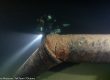
The wreck of HMHS Britannic is at 37°42′05″N 24°17′02″E in about 400 feet (122 m) of water. It was discovered on 3 December 1975 by Jacques Cousteau who explored it
In filming the expedition, Cousteau also held conference on camera with several surviving personnel from the ship including Sheila MacBeth Mitchell, a survivor of the sinking. In 1976, Cousteau entered the wreck with his divers for the first time. He expressed the opinion that the ship had been sunk by a single torpedo, basing this opinion on the damage to her plates.
The ship lies on her starboard side hiding the zone of impact with the mine. There is a huge hole just beneath the forward well deck. The bow is heavily deformed and attached to the rest of the hull only by some pieces of C-deck. This is the result of the massive explosion that destroyed the entire part of the keel between bulkheads two and three and, due to sinking in only 400 feet (120 m) of water, the bow hit the seabed before the entire length of the 882 ft 9 in (269 m) liner was completely submerged. Despite this, the crew’s quarters in the forecastle were found to be in good shape with many details still visible. The holds were found empty.
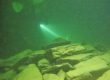
The forecastle machinery and the two cargo cranes in the forward well deck are well preserved. The foremast is bent and lies on the sea floor near the wreck with the crow’s nest still attached on it. The bell was not found. Funnel #1 was found a few metres from the Boat Deck. The other three funnels were found in the debris field (located off the stern).[76] Pieces of coal lie beside the wreck. The wreck of Britannic is in excellent condition, and the only signs of deterioration are the children’s playroom and some of the captain’s quarters, but the rest of the ship is in outstanding shape. The wreck is listed as a British war grave and any expedition must be approved by both the British and Greek governments.
In mid-1995, in an expedition filmed by NOVA, Dr Robert Ballard, best known for having discovered the wrecks of RMS Titanic in 1985, and the German battleship Bismarck in 1989, visited the wreck, using advanced side-scan sonar. Images were obtained from remotely controlled vehicles, but the wreck was not penetrated. Ballard found all the ship’s funnels in surprisingly good condition. Attempts to find mine anchors failed.
In August 1996, the wreck of HMHS Britannic was bought by Simon Mills, who has written two books about the ship: Britannic – The Last Titan and Hostage To Fortune.
In November 1997, an international team of divers led by Kevin Gurr used open-circuit trimix diving techniques to visit and film the wreck in the newly available DV digital video format.
In September 1998, another team of divers made an expedition to the wreck. Using diver propulsion vehicles, the team made more man-dives to the wreck and produced more images than ever before, including video of four telegraphs, a helm and a telemotor on the captain’s bridge. John Chatterton became the first diver to visit Britannic using a closed-circuit rebreather, but his efforts to penetrate the firemen’s tunnel using a rebreather were hampered by the poor reliability. The expedition was regarded as one of the biggest wreck diving projects ever undertaken. Time magazine published images shot in the expedition.
In 1999, GUE, divers acclimated to cave diving and ocean discovery, led the first dive expedition to include extensive penetration into Britannic. Video of the expedition was broadcast by National Geographic, BBC, the History Channel and the Discovery Channel.
In September 2003, an expedition led by Carl Spencer dived into the wreck. This was the first expedition to dive Britannic where all the bottom divers were using closed circuit rebreathers (CCR). Diver Rich Stevenson found that several watertight doors were open. It has been suggested that this was because the mine strike coincided with the change of watches. Alternatively, the explosion may have distorted the doorframes. A number of mine anchors were located off the wreck by sonar expert Bill Smith, confirming the German records of U-73 that Britannic was sunk by a single mine and the damage was compounded by open portholes and watertight doors. Spencer’s expedition was broadcast extensively across the world for many years by National Geographic and the UK’s Channel 5.
Also in the expedition was microbiologist Dr Lori Johnston, who placed samples on Britannic to look at the colonies of iron-eating bacteria on the wreck, which are responsible for the rusticles growing on Titanic. The results showed that even after 87 years on the bottom of the Kea Channel, Britannic is in much better condition than Titanic because the bacteria on her hull have too much competition and are actually helping protect the wreck by turning it into a man-made reef.
In 2006, an expedition, funded and filmed by the History Channel, brought together fourteen skilled divers to help determine what caused the quick sinking of Britannic. After preparation the crew dived on the wreck site on 17 September. Time was cut short when silt was kicked up, causing zero visibility conditions, and the two divers narrowly escaped with their lives. One last dive was to be attempted on Britannic‘s boiler room, but it was discovered that photographing this far inside the wreck would lead to violating a permit issued by the Ephorate of Underwater Antiquities, a department within the Greek Ministry of Culture. Partly because of a barrier in languages, a last minute plea was turned down by the department. The expedition was unable to determine the cause of the rapid sinking, but hours of footage were filmed and important data was documented. Underwater Antiquities later recognised the importance of this mission and subsequently extended an invitation to revisit the wreck under less stringent rules. On this expedition, divers found a bulb shape in her expansion joint. This proved that her design was changed following the loss of Titanic.
On 29 May 2009, Carl Spencer, drawn back to his third underwater filming mission of Britannic, died in Greece due to equipment difficulties while filming the wreck for National Geographic.
In 2012, on an expedition organised by Alexander Sotiriou and Paul Lijnen, divers using rebreathers successfully installed and recovered scientific equipment used for environmental purposes, to determine how fast bacteria are eating Britannic‘s iron compared to Titanic.